Will Madonna and Sandra Bernhard Ever Be Friends Again
During near five decades in showbiz, Sandra Bernhard has racked upwardly championship after title – comedian, actor, singer, author, radio host – and a reputation for controversy. She has worked with a long list of superstars, from Richard Pryor and Robin Williams to Robert De Niro and Cyndi Lauper. Only she has never been overshadowed; her force of personality has guaranteed that. Even 30 years ago, the Los Angeles Times was paying homage to her "acid-tongued, combative persona".
But in that location are no cutting remarks today. On this sunny morning time in Los Angeles, she appears relaxed, in a pink-striped shirt and trousers, reminiscent of the early 80s outfits she wore for her many appearances on Late Nighttime With David Letterman.
It is well-nigh a year since she finished filming the final series of Pose, the much-praised TV drama exploring the ball scene in 80s New York and the gay and transgender artists who built it. Bernhard plays Judy Kubrak, a nurse caring for people dying with Aids. Judy has an activist streak, bringing other characters into the fight against neglectful politicians and cruel pharmaceutical companies.
When I got the role on Pose, it was kind of full circumvolve. I had been role of it, seen my friends in infirmary and known what people went through: the degradation, loneliness and alienation
It feels like the perfect role for Bernhard, who has ever laced her shows with political commentary, has been open about her own bisexuality and was embedded in New York'due south cultural hole-and-corner during the ball era. She remembers that time fondly: "At that place were events and art openings, fashion shows and parties. For sure, in that location was a gay scene, but everything sort of melded together."
Information technology was there she met her longtime musical manager, Mitch Kaplan, and the conceptual creative person John Boskovich. Together, they adult her quantum one-woman show, Without You I'yard Nothing, With Yous, I'one thousand Not Much Better, which she performed off-Broadway in 1988. "Near every dark, we went out later, dancing, or hung out on Second Avenue. There were a lot more than people on the street. It was only a more accessible, affordable state of affairs back so."

Still the era was tinged with tragedy as Aids took hold. "I lost many, many expert friends. We were all terrified and sad," Bernhard says. It was specially tough for trans people. "Back then, if you lot were trans, chances are you lot lived on the street, yous hustled and you probably contracted Aids," she says. "Nobody took trans people seriously. The underlying theme of Pose was to really honour that community's work and artistry.
"When I got the role on Pose, it was kind of full circle. I had been function of information technology, seen my friends in infirmary and known what people went through: the degradation, loneliness and alienation. At that place was a lot to inform my operation."
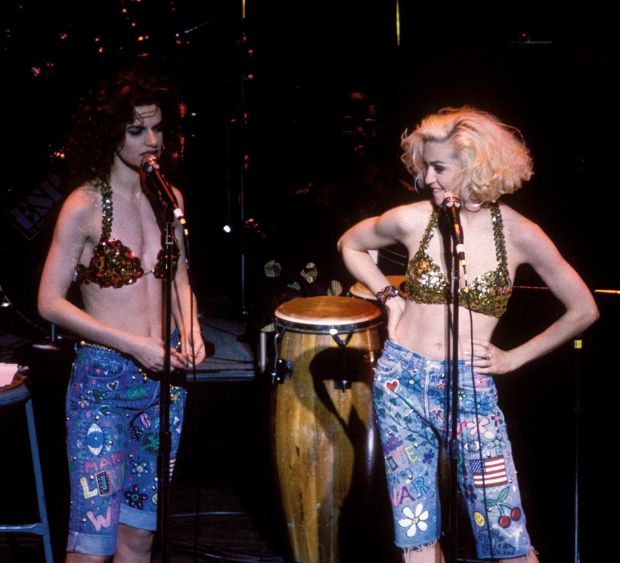
One relationship from this time notwithstanding trails Bernhard from interview to interview: her friendship with Madonna. "Nosotros'd met many times, only she didn't seem that interested in existence friends until she came to encounter my evidence in New York," she says. "We kind of clicked so."
The pair began hanging out, going to parties and plays. In July 1988, Bernhard was on Letterman once more and brought a surprise: Madonna. The pair, dressed in matching denim shorts, white T-shirts and talocrural joint socks, wrested control from the helpless host.
'Two women hanging out? Of course it's going to be sexual,' Bernhard says with perfect sarcasm. 'I hateful, we kind of flirted with that purposefully. We left it cryptic and crazy; it was well-nigh like an ongoing performance piece'
Rumours of an affair followed them. "Two women hanging out? Of class it's going to be sexual," Bernhard says with perfect sarcasm. "I mean, we kind of flirted with that purposefully. Nosotros left information technology ambiguous and crazy; it was almost like an ongoing functioning piece."
Bernhard, who is at present 66, has never made a secret of her bisexuality. She has been with her partner, Sara Switzer, formerly an editor at Harper'southward Bazaar, for more ii decades. They met in the late 90s, not long after Bernhard gave birth to her girl Cicely, whom they raised in New York. She has never named Cicely'due south father.
Despite her protestations ("I never tried to be revolutionary with my sexuality"), this is a big deal, given how few high-contour LGBTQ+ women there were until recently. Fifty-fifty Ellen DeGeneres's "coming out" episode didn't air until 1997 and was treated every bit scandalous by some corners of the media. Bernhard says: "I didn't feel like I was trying to make whatsoever big statement. That'south just who I was and what I was comfy being. I e'er thought: just get over it and be who you lot are. When you lot're not hiding, that'south the inspiration for people."
In 1991, she joined the cast of Roseanne, playing Nancy Bartlett, who started out in a straight matrimony, but after a year began dating a adult female. Nancy was the first recurring bisexual US sitcom character. Still, Television executives were far from open-minded. During a Christmas episode, Nancy and her girlfriend were shown beneath the mistletoe, simply they were not allowed to osculation. "I idea it was completely unsophisticated and stupid," Bernhard says. "Only we set the tone for people who, when things loosened up, got to practise something more."
Despite being nonchalant well-nigh its significance at the time, she knows now what it meant to many viewers. "People who maybe lived in repressed households were like: 'You were my lifeline – that character made me feel so confident,'" she says. "When you're not thinking well-nigh the impact and people years later tell you that, y'all're like: 'Wow, I'1000 so glad.'"
Elsewhere, she has been more intentional in tackling big issues: "I wanted to say important things when the time was correct." In September, she will perform at a nighttime to raise funds for Abortion Access Front, at a time when reproductive rights are facing legal challenges across the US. Recently, she has shared her disdain for anti-vaxxers and fatigued attention to the water crisis in Flint, Michigan, her abode town.
My No 1 obsession is abortion rights – I can't believe we're back fighting this again. It'due south infuriating. I will always be a proponent of women having exactly what they demand to control their destinies
Her politics have non inverse since the 70s, she says: "I want things to keep moving to the left. I want equality. I've been thinking and fighting virtually the same things since I was a teenager, because nothing has been actually, truly resolved. My No 1 obsession is abortion rights – I tin can't believe we're back fighting this over again. It's infuriating. I volition ever exist a proponent of women having exactly what they need to control their destinies."
Born into a "liberal Jewish household", the youngest of four children and the only daughter of Jeanette (an artist) and Jerome (a physician), Bernhard has been performing since the age of five. "I loved singing, I loved making people laugh," she says. "I was a chip of a mimic – very interested in people, hyperfocused on funny footling habits."
She was ofttimes taken to the theatre, where "bigger-than-life" acts such as Carol Channing caught her attention. When her parents hosted dinners, Bernhard mingled with guests, soaking up the glamour: "I was always interested in older people and what they had to say. I aspired to be such a sophisticated person." By the time the family moved to Arizona, 10-twelvemonth-old Bernhard was taking opera lessons.
In 1974, a teenaged Bernhard, fresh from vacuuming hearts out of kosher chickens on a kibbutz, decided to follow her dreams to LA. Only at that place were bills to pay, so she enrolled at dazzler schoolhouse, qualified as a manicurist and began 5 years working at a salon in Beverly Hills. Some of her regulars were stars – Dyan Cannon, Victoria Principal, Jaclyn Smith. While the women sat under big, old-schoolhouse hairdryers, Bernhard painted their nails – "more often than not classic ruby".

She made friends easily ("actually great kids that I met in line at The Rocky Horror Show") and started developing "a little routine" for stage. A cabaret vocalizer she had met at beauty schoolhouse took her to an open-mic night at Ye Picayune Guild to try it out. "I'd put together this safari outfit: shorts and jacket, lace-up espadrilles, a beautiful little lid," Bernhard says. "My first joke, I looked at the audience and said: 'I'm a medium. [Pointing] I hear you're a small and you're an extra-large.'" She followed upwards with a Mary Tyler Moore impression and "funny, observational, weird stuff", she says. "I was right in my milieu. I loved information technology."
That night, she met two important mentors – the comedians Paul Mooney and Lotus Weinstock. Mooney connected Bernhard with the One-act Store in West Hollywood – where she became a regular – and Richard Pryor, on whose sketch show she appeared in 1977 as an unhinged flying bellboy and a glam-stone fan, also every bit in improv scenes.
Every night, she went to a different comedy order, sometimes waiting three hours for a few minutes on stage. "My whole life was dedicated to that. I'd work during the day, come up dwelling and nap, then go to the comedy places," she says. "I never drank, never did drugs; I was laser-focused." She learned how to control a oversupply and deal with heckles, "taking the piss out of people in a funny, cute way".
Men comics weren't standing at the back judging y'all and you weren't worried nearly following a man who was doing really sexist, misogynistic material. I gained a lot of conviction in that realm
In 1978, the Comedy Store opened the Belly Room, a dedicated space for female performers. There wasn't always an audience, but there were upsides: "Things flowed a lot easier, because men comics weren't standing at the dorsum judging you and y'all weren't worried virtually post-obit a human being who was doing really sexist, misogynistic fabric. I gained a lot of confidence in that realm."
Whatever room she played, she asserted her sexuality, sometimes using it to embarrass men in the audience. "No woman had really washed that before," Bernhard says. "I didn't want men to call back they controlled me. I'm in control of my life and you lot couldn't invade it if you tried."
This bold facade served her well. The #MeToo movement unearthed dark behaviour from many men in entertainment. In comedy in the 70s and 80s, she says, "men were entitled in a style that yous can't fifty-fifty imagine now. We've all been sexually harassed – it's a given. But, for me personally, I was never a victim of annihilation I would wait at and get: 'Oh my God, I survived that.' Developing my armour as a performer kept people at bay." She as well had Mooney: "He was my buffer in a lot of situations. He was a really bully marry. I was lucky."
Singing go a central part of her alive act. She released studio albums, besides. In her breakthrough film office, every bit the celebrity-stalker Masha in Martin Scorsese'south 1982 movie The King of Comedy, her song talents added another layer to her most captivating scene. Masha had kidnapped Jerry Lewis'southward character and taped him to a chair, ready for a tense, one-sided dinner date. She told him she was feeling "completely impulsive … annihilation could happen", before sweeping the table'southward contents to the floor and breaking into song.
Bernhard was likewise given liberty to employ her LA-honed improv skills: "To accept Jerry Lewis as the foil was brilliant, because he was a renowned misogynist, so him being tied up and unable to do anything about it worked on a lot of different levels."
Condign this erratic grapheme was surprisingly easy. "I didn't have to prepare much," she says. "That corybantic free energy, craziness and intensity was who I was in my alive performances."
Now more always, the stage the but place you can really say what you want. Information technology's one thing to plough on a Tv set evidence, but if you're buying a ticket and showing upwardly to a alive venue, y'all actually desire to hear what that person has to say
The film earned her the best supporting extra honour from the National Society of Film Critics and raised her profile hugely. Did it result in whatever Masha-similar superfans of her ain? "At that place were a few people who would come up to my shows over and over, who were a picayune bit of a nuisance. In New York, people would follow you around, but I never thought of it in a menacing way."
Social media, despite offering direct admission, has made it easier to deal with admirers, Bernhard says: "Everybody thinks they're a star, and then nobody has time to bother with the people that actually are stars."
The net has undoubtedly created new challenges, though – especially for comedians, with the threat of onetime textile surfacing at any time. Final year, Naomi Campbell criticised Bernhard's use of the N-word during a joke about Mariah Carey in a 90s comedy special, saying: "It was so rude and disrespectful … completely racist."
Does Bernhard regret any of the jokes she has fabricated? No, she says, because they aligned with what she felt was adequate "social commentary" at the time. But she adds that comedians must evolve with societal shifts: "It forces y'all to constantly renew how you write and how you remember." Rather than doubling downwardly on the norms of by decades, "yous suit your material and approach. That's office of evolving as an artist."
She hopes that development involves "continuing to discover myself equally a person and a performer". She wasn't entirely idle during the pandemic: she continued her radio show, Sandyland, interviewing everyone from abortion access campaigners and trans-rights activists to stars such as Mena Suvari and Billy Porter. Just she found a quieter side: "Information technology was a relief not to have to run around all the time. In that location was something very meditative near the experience. I'll behave that on into the rest of my life."
At present she is back in LA to work on her first live show since the globe went into lockdown. We take to wrap up as Kaplan arrives for rehearsals. "We've been working together since 1985," she says. "Information technology's crazy."
She can't wait to get back on stage. "Now more than ever, it's the simply identify you tin actually say what you want," she says. "It's one thing to turn on a Boob tube show, merely if y'all're ownership a ticket and showing up to a live venue, yous actually want to hear what that person has to say." – Guardian
Pose continues on BBC Two on Lord's day at midnight
Source: https://www.irishtimes.com/culture/tv-radio-web/sandra-bernhard-on-madonna-two-women-hanging-out-of-course-it-s-going-to-be-sexual-1.4649247
0 Response to "Will Madonna and Sandra Bernhard Ever Be Friends Again"
Post a Comment